
The ICT Trading Style: A Complete Guide to Liquidity, Fair Value Gaps, Break of Structure, Market Structure Shifts, and the Logic Behind Price Delivery.
Not your avg Substack Furu article.

NOTE: The Substack will remain free for those wondering. However, I have enabled the paid option ($8/month) , like I announced on my X yesterday, the proceeds will be donated to a dog rescue charity in Central FL. If you enjoy these and get any value consider joining others in such a great cause. I also have planned to add extra value to those that join with the $8 dollars a month in a few different ways that I think you will enjoy later on.
The ICT style of trading, short for Inner Circle Trader, is built around the idea that markets do not move randomly from candle to candle. Price is constantly moving between areas of liquidity, imbalance, inefficiency, and repricing. The entire framework is based on understanding how price is delivered, where participants are likely trapped, where stops are resting, and where the market has unfinished business.
At its core, ICT is not about indicators. It is not about buying because the RSI is oversold or selling because a moving average crossed another moving average. It is a way of reading the auction. Price moves to collect orders. That is the foundation.
Every buy order needs a seller. Every sell order needs a buyer. When institutions, large funds, dealers, algorithms, or aggressive participants need to enter or exit size, they need liquidity. The market seeks areas where enough orders exist to facilitate that size. Most of those orders are not sitting in random places. They are usually clustered around obvious highs, obvious lows, session extremes, round numbers, trendline breaks, prior day levels, and areas where retail traders are likely to place stops.
This is why the ICT style often feels like it explains the cruelty of the market. The high gets taken right before price reverses. The low gets swept right before a rally. A clean breakout fails. A perfect support level breaks, triggers panic selling, then violently reclaims.
To the average trader, that feels like manipulation.
To an ICT trader, that is liquidity being engineered and consumed.
This article is a complete guide to the core ICT concepts: liquidity, fair value gaps, break of structure, market structure shifts, displacement, order blocks, premium and discount, kill zones, and the full trade model behind the style.
The goal of this article is not to turn ICT into religion or a weird cult. The goal is to understand the logic behind it, where it works, where traders overcomplicate it, and how to use it as a practical framework instead of a chart astrology system.
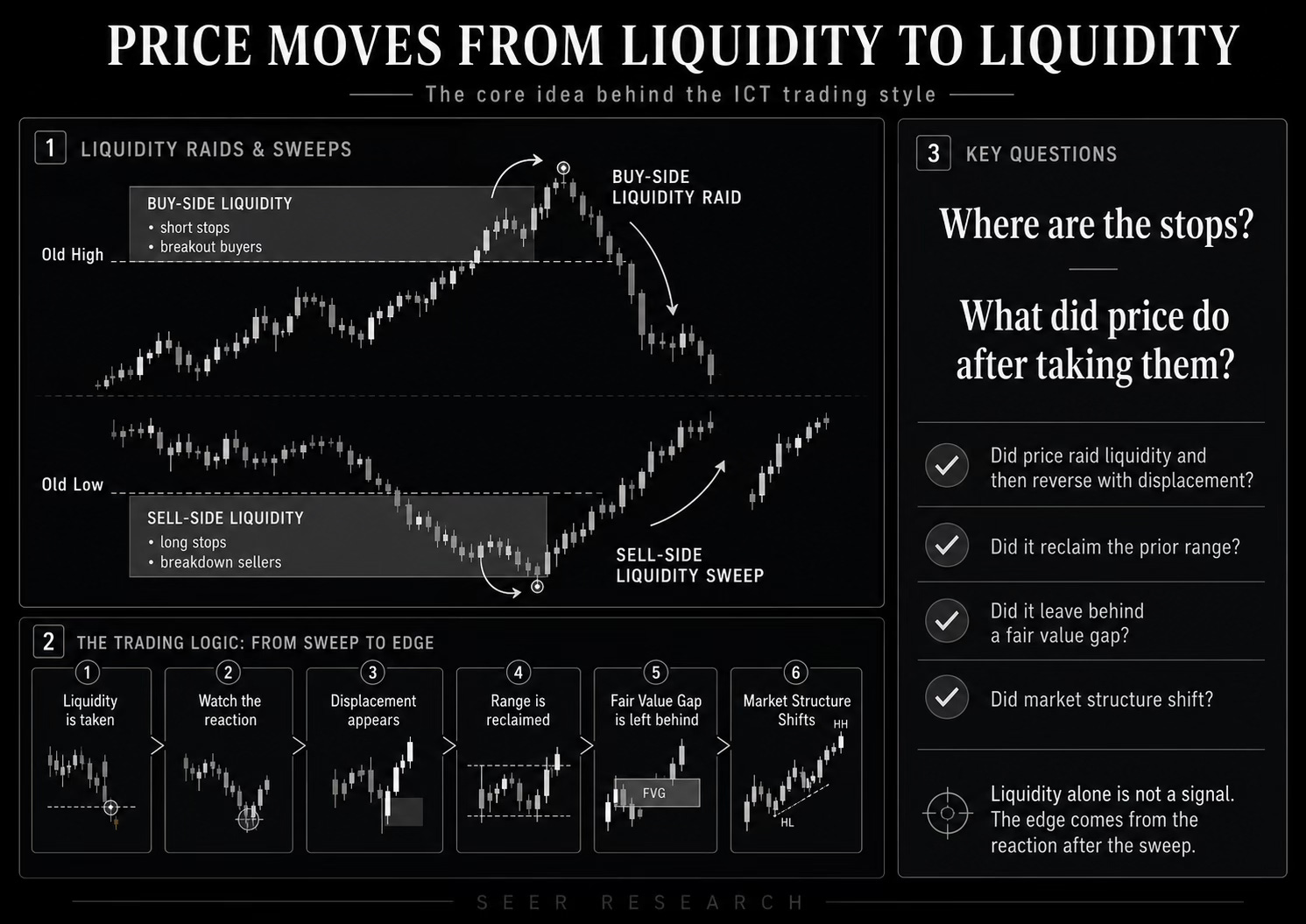
The Core Idea: Price Moves From Liquidity to Liquidity
The market is an auction, but it is also a battlefield of positioning.
Every visible high and low on a chart tells a story. Above an old high, there are likely buy stops from short sellers. There may also be breakout buyers waiting to enter once price clears resistance. Below an old low, there are likely sell stops from long traders. There may also be breakdown sellers waiting to enter once price loses support.
These areas become magnets because they hold a lot of liquidity.
In ICT language, liquidity is not just volume. It is the pool of resting orders that price can draw into. Liquidity is where the market can find counterparties.
This is why price often behaves in a way that frustrates simple technical analysis. A retail trader sees resistance and expects price to reject before touching it. But price often pushes slightly above resistance first, triggers stops and breakout longs, then reverses. The move above the high was not necessarily bullish continuation. It may have been a buy-side liquidity raid.
The same applies below support. A level breaks, traders panic, stops trigger, shorts chase, and then price reclaims the level. That move may have been a sell-side liquidity sweep.
The first thing an ICT trader asks is simple:
Where are the stops?
The second question is even more important:
What did price do after taking them?
Because liquidity alone is not a trade signal. Price can take buy-side liquidity and keep running higher. Price can take sell-side liquidity and keep collapsing lower. The real information comes from the reaction after the sweep.
Did price raid liquidity and then reverse with displacement?
Did it reclaim the prior range?
Did it leave behind a fair value gap?
Did market structure shift?
That sequence is where the model begins.
Buy-Side and Sell-Side Liquidity
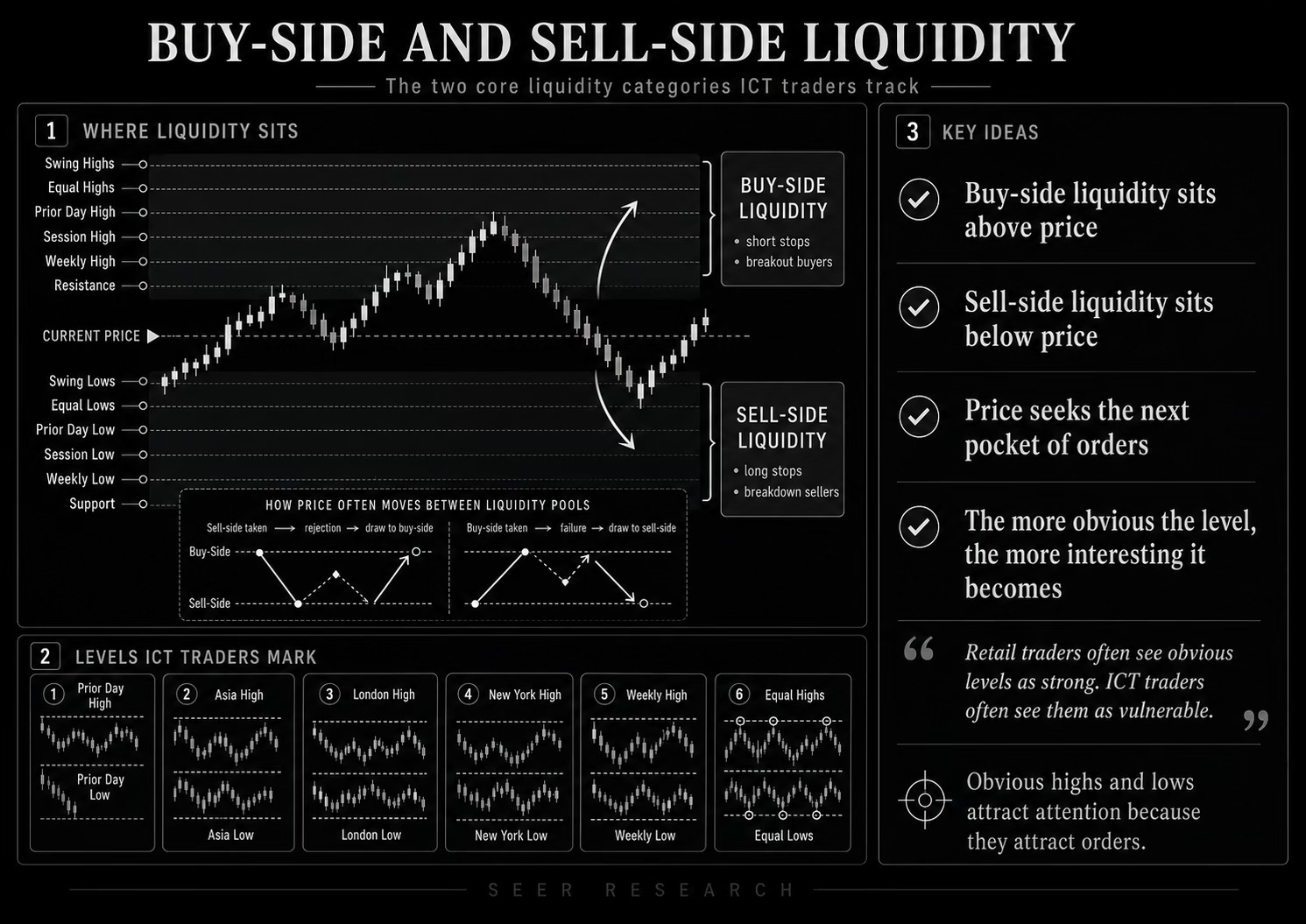
ICT traders divide liquidity into two simple categories: buy-side liquidity and sell-side liquidity. You always see these levels in the charts I post on X.
Buy-side liquidity sits above price. It is usually found above swing highs, equal highs, prior day highs, session highs, weekly highs, and obvious resistance zones. These are places where short sellers have stops and breakout traders have buy orders.
Sell-side liquidity sits below price. It is usually found below swing lows, equal lows, prior day lows, session lows, weekly lows, and obvious support zones. These are places where long traders have stops and breakdown traders have sell orders.
The market often moves toward one side of liquidity before reversing toward the other side.
Think of price as constantly seeking the next pocket of orders. If the market has already taken sell-side liquidity and aggressively rejects lower prices, the next draw may be buy-side liquidity above. If the market has already taken buy-side liquidity and fails to continue, the next draw may be sell-side liquidity below.
This is one reason ICT traders spend so much time marking previous highs and lows. Prior day high. Prior day low. Asia high. Asia low. London high. London low. New York session high. New York session low. Weekly high. Weekly low. Equal highs. Equal lows. The more obvious the level, the more interesting it becomes.
Retail traders often think an obvious level is strong because everyone can see it. ICT traders often think an obvious level is vulnerable because everyone can see it. That difference matters.
Equal Highs and Equal Lows: The Liquidity Trap
Equal highs and equal lows are among the cleanest liquidity concepts in ICT.
Equal highs form when price creates two or more highs around the same level. Retail traders often interpret this as resistance. They may short into it, expecting the level to hold. Their stops often sit slightly above the highs.
That cluster of stops becomes buy-side liquidity.
Equal lows work the same way in reverse. Price forms two or more lows around the same area. Retail traders interpret it as support. They buy the level and place stops slightly below it.
That cluster of stops becomes sell-side liquidity.
This is why equal highs and equal lows are often attacked. The market is not attacking them because the chart pattern is special. It is attacking them because they represent concentrated orders.
A clean ICT setup often begins with price moving into one of these pools, taking it out, and then failing to continue. That failure is key. A liquidity sweep only becomes meaningful when the market shows rejection afterward.
For example, imagine price forms equal lows during the London session. New York opens, pushes below those lows, triggers stops, and then quickly reclaims the level. If price then breaks above a short-term swing high with strong displacement, an ICT trader may view that as a market structure shift. The sweep below the lows provided the liquidity. The displacement showed intent. The fair value gap left behind may become the entry zone.
Liquidity first. Displacement second. Retracement third. Continuation fourth.
Liquidity Sweeps Versus Breakouts
One of the most important skills in ICT is learning to distinguish between a true breakout and a liquidity sweep.
A breakout implies continuation. Price clears a level, accepts beyond it, and continues in the breakout direction.
A liquidity sweep implies rejection. Price clears a level, triggers orders, fails to hold beyond it, and returns back inside the prior range. You have seen me use this multiple times when I mention “id like it over X level and fail to hold to buy puts”.
The difference is not always obvious in real time, but there are clues.
A sweep often has a fast wick through a level, followed by a sharp rejection. The candle may close back inside the prior range. The move may happen during a high-volume session open or around a news catalyst. Price may then displace in the opposite direction.
A true breakout usually shows acceptance. Price breaks the level, holds above it, retests it, and continues. It does not immediately collapse back through the level.
The mistake many traders make is assuming every run above a high is bearish and every run below a low is bullish. That is not ICT. That is just fading momentum blindly. The market can sweep liquidity and continue. In a strong trend, buy-side liquidity raids can become fuel for higher prices. Sell-side liquidity raids can become fuel for lower prices.
The context matters.
What is the higher timeframe bias? Where is price relative to premium and discount? Was liquidity already taken on one side? Did the move create displacement? Did market structure shift? Is price trading toward a higher timeframe draw on liquidity?
ICT is not about one candle. It is about the sequence.
Fair Value Gaps: The Imbalance in Price Delivery
Fair value gaps, usually shortened to FVGs, are one of the most popular ICT concepts.
A fair value gap represents an imbalance in price delivery. It forms when price moves so aggressively in one direction that the market does not trade efficiently through a small range of prices.
The most common three-candle definition is simple.
In a bullish fair value gap, the low of the third candle is above the high of the first candle. That leaves an area between the first candle high and the third candle low where price moved too quickly and left an inefficiency.
In a bearish fair value gap, the high of the third candle is below the low of the first candle. That leaves an area between the first candle low and the third candle high where price moved too quickly to the downside.
The middle candle is usually the displacement candle.
Why does this matter?
ICT traders believe price often returns to these imbalances before continuing in the direction of the displacement. The fair value gap acts like a repricing zone. It is not support or resistance in the traditional sense. It is an area where the market may rebalance before continuing toward the next draw on liquidity.
For a bullish setup, price may sweep sell-side liquidity, reverse aggressively, create a bullish fair value gap, then retrace into that gap. The retracement into the gap can offer a long entry, especially if it aligns with discount pricing, an order block, or a higher timeframe bias.
For a bearish setup, price may sweep buy-side liquidity, reverse aggressively, create a bearish fair value gap, then retrace into that gap. The retracement into the gap can offer a short entry, especially if it aligns with premium pricing and a bearish draw on liquidity below.
The fair value gap is not magic. It is useful because it gives the trader a precise area to define risk and entry. But not all fair value gaps matter. This is where many traders ruin the concept.
Every chart is full of tiny gaps if you zoom in far enough. If you mark every single FVG, your chart becomes useless. The best fair value gaps usually appear after a meaningful liquidity event and a strong displacement move. They are more important when they align with the higher timeframe narrative.
A random FVG in the middle of a choppy range is noise.
A clean FVG after a liquidity sweep and market structure shift is information.
Break of Structure and Market Structure Shift
Break of Structure, often written as BOS, and Market Structure Shift, often written as MSS, are related but not identical.
A Break of Structure usually refers to price continuing in the direction of the existing trend by breaking a prior structural high or low.
In an uptrend, price makes higher highs and higher lows. A break above a prior high can be considered a bullish break of structure because it confirms continuation.
In a downtrend, price makes lower lows and lower highs. A break below a prior low can be considered a bearish break of structure because it confirms continuation.
Market Structure Shift is more important for reversals.
A bullish MSS happens when price was previously moving lower, takes sell-side liquidity, then breaks above a meaningful lower high with displacement. This suggests the short-term order flow may have shifted from bearish to bullish.
A bearish MSS happens when price was previously moving higher, takes buy-side liquidity, then breaks below a meaningful higher low with displacement. This suggests the short-term order flow may have shifted from bullish to bearish.
The key word is meaningful.
A lot of traders label every tiny break as MSS. That creates noise. A true market structure shift should break a swing that actually matters to the recent price leg. Ideally, it happens after a liquidity sweep and with visible displacement.
A clean bullish sequence looks like this:
Price trades lower. Price takes a prior low. Price rejects lower prices. Price displaces higher. Price breaks a prior lower high. Price leaves behind a bullish fair value gap. Price retraces into the gap. Price continues toward buy-side liquidity.
A clean bearish sequence looks like this:
Price trades higher. Price takes a prior high. Price rejects higher prices. Price displaces lower. Price breaks a prior higher low. Price leaves behind a bearish fair value gap. Price retraces into the gap. Price continues toward sell-side liquidity.
That is the classic logic. Again, the sequence matters more than the label.
Order Blocks: The Last Opposing Candle Before Displacement
Order blocks are another major ICT concept, and also one of the most misunderstood.
An order block is commonly described as the last down candle before a bullish displacement move, or the last up candle before a bearish displacement move. You have also seen this on the charts I post, showing a +OB or -OB for bullish or bearish order block.
The idea is that before price aggressively moves in one direction, smart money may have accumulated or distributed positions around the prior candle. When price returns to that area, it may react because that zone represents institutional activity or an origin point of displacement.
A bullish order block is usually the last bearish candle before a strong move higher.
A bearish order block is usually the last bullish candle before a strong move lower.
But once again, not every candle is an order block worth trading.
A useful order block should have context.
It should appear near a liquidity event. It should precede displacement. It should align with the higher timeframe bias. It should sit in a logical premium or discount zone. It should offer clean invalidation.
The worst way to use order blocks is to mark every last red or green candle and assume price must reverse there. That turns the concept into decoration.
The best way to use order blocks is to treat them as potential refinement zones inside a larger model.
For example, after a bullish liquidity sweep and MSS, price may retrace into a bullish FVG. Inside or near that FVG, there may also be a bullish order block. That overlap creates confluence. The trade is not long because of the order block alone. The order block simply helps refine the entry.
Liquidity sets the trap. Displacement shows intent. Structure confirms the shift. FVGs and order blocks refine entry. Premium and discount improve location. Risk management decides whether the trade is worth taking.
The Draw on Liquidity
A draw on liquidity is the area price is likely reaching for next.
This can be an old high, old low, equal highs, equal lows, a previous day high, a previous day low, a weekly level, an imbalance, or any other pool of orders the market may seek. The draw on liquidity gives the trade a destination.
Without a destination, traders often exit randomly. They panic out early, hold too long, or move targets based on emotion. A draw on liquidity gives structure to the idea.
For example, if price sweeps the London low during New York, forms a bullish MSS, and begins trading higher, the draw may be the London high or the prior day high. That gives the trader a logical target.
If price sweeps the prior day high and rejects, the draw may become the New York session low or an unfilled sell-side imbalance below. The draw can change as price develops. This is why ICT requires active reading, not blind prediction.
A trader may start the day expecting buy-side liquidity to be targeted. But if price takes that liquidity early, rejects hard, and shifts structure lower, the draw may flip to sell-side liquidity. The chart is always updating. The best traders are not loyal to a bias after the market invalidates it.
udas Swing: The False Move Before the Real Move
The Judas Swing is another concept often associated with ICT.
It refers to an early false move that tricks traders into the wrong direction before the real directional move begins.
For example, during the London or New York session, price may initially rally above a short-term high, convincing traders that the session is bullish. That move may only be a run on buy-side liquidity. After trapping breakout buyers, price reverses and sells off for the true move of the session.
The opposite can happen when price flushes below a low, traps shorts, then reverses higher.
The Judas Swing is essentially a liquidity trap.
It is not a separate magic pattern. It is the same idea repeated through time and session behavior. The market creates an obvious move, draws in traders, raids liquidity, then reverses toward the true draw. This is why early session moves should be treated carefully. The first move is not always the real move.
Final Thoughts: ICT Is a Lens, Not a Religion
The ICT trading style is powerful because it forces traders to think beyond patterns. It teaches that highs and lows are not just chart points. They are liquidity pools. It teaches that violent moves often leave imbalances. Those imbalances can become retracement zones. It teaches that reversals require more than hope. They require liquidity, rejection, displacement, and structure shift.
It teaches that location matters. Buying in discount is different from chasing premium. Selling in premium is different from shorting after the move is already extended.
Most importantly, ICT teaches traders to ask better questions.
Where is liquidity resting? Who is trapped? Where did price move inefficiently? What level would prove the idea wrong? Where is price likely delivering next?
That is the real value.
The danger is turning ICT into a vocabulary contest. Knowing the words FVG, MSS, BOS, OB, breaker, mitigation block, and liquidity sweep does not make someone profitable. The market does not pay for terminology. It pays for execution, patience, risk control, and the ability to stay selective when nothing clean is happening.
Use ICT as a lens.
Use it to understand liquidity.
Use it to improve trade location.
Use it to avoid being the liquidity.
But do not worship the model.
The best traders are not loyal to acronyms. They are loyal to process. And the process is simple, even if the execution is hard.
Find liquidity. Wait for the raid. Demand displacement. Confirm the shift. Enter on repricing. Target the next pool. Protect capital when the sequence is not there.
That is the ICT style in its cleanest form. Not magic. Not certainty.
Just a structured way to read how price hunts orders, fills inefficiencies, traps participants, and moves from one pocket of liquidity to the next.
Tremendous!! I have joined the $8 a month!! LFG!!